top of page


YOU MAY NOT NEED ANOTHER PROTOCOL.
You may need a better way to determine what the body is ready to do next.
Most practitioners already know what many interventions are intended to do. The harder question is whether that direction matches the body’s present physiological state.
You may already have encountered cases in which:
-
an intervention helps for a time, then stops working;
-
two apparently similar patients respond in opposite ways;
-
one symptom improves while the person becomes less stable overall;
-
a previously tolerated supplement, treatment or activity suddenly causes difficulty;
-
the individual findings appear valid, yet the whole case still does not make sense;
-
everything seems relevant, but it remains unclear what should come first.
These responses are not necessarily random, nor do they always mean that another test, protocol or intervention is required. They may indicate that physiological hierarchy, compensation, timing and present capacity have not yet been established.
Systems Regulation in Clinical Practice was developed to teach this missing layer of clinical reasoning: how to determine what the body is already doing, what it is compensating for and what kind of move it may be able to complete next.
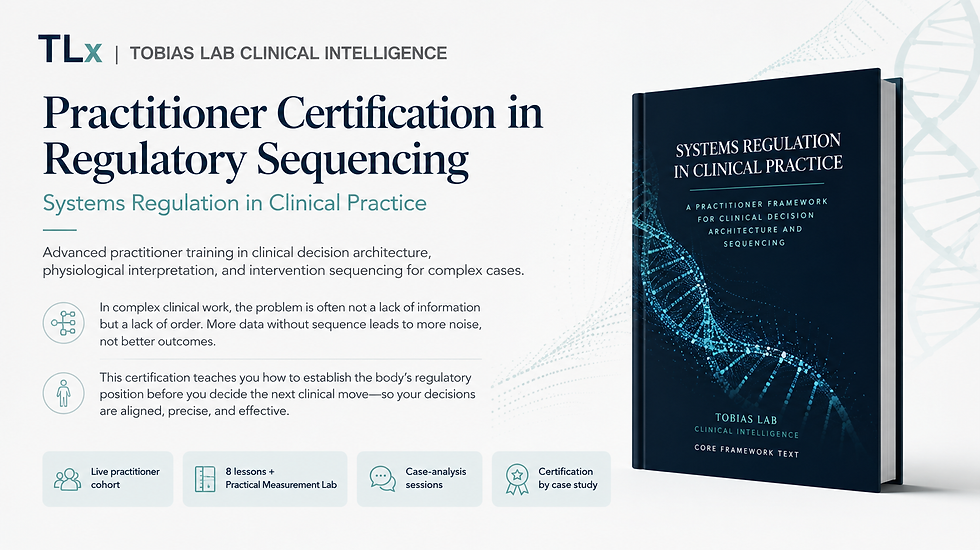
The Practitioner Certification in Regulatory Sequencing turns this reasoning into a structured clinical method for establishing regulatory position, interpreting layered signals and deciding what kind of move the body can appropriately manage next. The emphasis is not on collecting more protocols, but on developing clearer clinical reasoning before intervention.


Physiological Measurement and Interpretation
The program teaches practitioners how to collect and interpret a focused set of physiological measurements, including:
-
urine pH, conductivity, and specific gravity;
-
saliva pH and conductivity;
-
supine and standing blood pressure and heart rate;
-
orthostatic differentials;
-
respiration rate and oxygen saturation;
-
temperature and related regulatory observations.
These findings are not treated as isolated numbers to correct. Practitioners learn how collection time, preparation, symptoms, medications, food, fluids, activity, illness, and longitudinal context can change the meaning of a result. A dedicated Practical Measurement Lab provides instruction in collection technique, meter use, timing, repeatability, and common measurement errors.

Certification
Certification is based on demonstrated application rather than attendance alone. Practitioners submit a structured case study showing competency in regulatory placement, signal hierarchy, physiological interpretation, stage-aligned sequencing, directional intervention logic, and longitudinal case reasoning.
Certification confirms demonstrated application of the Systems Regulation in Clinical Practice framework to a real clinical case.
Who This Training Is For
The program is intended for practitioners with relevant clinical education or substantial experience working with health, physiology, biological observation, or complex case assessment.
Applicants may include naturopathic, integrative, functional, nutritional, medical, nursing, and allied health practitioners, as well as biological microscopists, researchers, and other qualified professionals.
This is practitioner-level training, not introductory public health education. Admission is application-based.
Small-Cohort Learning
Cohort size is intentionally limited to support meaningful discussion, case interpretation, practitioner questions, and direct feedback. The purpose is not rapid-volume certification, but the development of careful and clinically useful reasoning.
Core Framework Text
The certification is built around Systems Regulation in Clinical Practice by Tobias Beharrell. The manual provides the structural foundation for regulatory placement, physiological hierarchy, measurement interpretation, timing, intervention bias, and stage-aligned sequencing.
It also remains a continuing practitioner reference after the live cohort concludes.
After Certification
Certified practitioners may be invited to advanced case-analysis sessions, practitioner-development meetings, measurement or microscopy workshops, in-person clinical intensives, framework updates, and future TLx clinical-system training.
Advanced activities are optional and separate from the initial certification program.

Request Program Information
Practitioners interested in the next cohort may request:
-
upcoming dates;
-
tuition and payment information;
-
application requirements;
-
course schedule;
-
technology and measurement requirements;
-
certification details.
Applications are now being accepted for the next practitioner cohort. Enrolment is limited to preserve instructional depth and meaningful case discussion.
Apply for the Next Practitioner Cohort
Tobias Lab Clinical Intelligence
tobiaslabcanada@gmail.com

Inquiries
bottom of page